
Stay Together, Have More Time to Play Together, But Most Importantly, Have Happier Mothers!!!
by Kathleen Slaugh Bahr, Kristine Manwaring, Cheri Loveless, and Erika Bailey Bahr - The Meanings and Blessings of Family Work
As a mother, I am constantly overwhelmed by the entropic nature of homemaking--once something is accomplished, it is quickly undone. Family work almost always leads to murmuring and complaining that is hard to endure. Couple that with an ideal image of what I want my house to look like and how specifically I want it to be cleaned and it's no wonder that I've become too lenient with my family. They hardly do anything "hard" around the house. If they have to clean up after themselves, life is terrible. It's no wonder I have been worn out and feel exhausted all the time. The following ideas taken from chapter 21 entitled, "Meanings and Blessings of Family Work" from "Successful Marriages and Families" inspired me. Reading the material changed my attitude which almost entirely helped me start making necessary changes in our home. Within days, my children are happily cooperating and even pitching in to help on their own. Just last Saturday, my youngest children were cleaning toilets! They did a pretty good job, too.
Consider This:
 In previous generations, families worked together for survival. All members of the family helped on the farm and produced what the family needed. Industrialization changed things. Husbands left the farm and found more dependable work in factories. Providing for a family turned into bringing home a paycheck. The work of mothers also changed. The principles of economics that made industries more efficient were applied to keeping a house. Machines took over what husbands and children use to help with, but mothers somehow experienced a longer work day. "Houses and wardrobes expanded, standards for cleanliness heightened, and modern appliances encouraged more elaborate meals preparation." Women were urged to take advantage of new products on the market. There was no reason to "waste" time making soap when you could buy it. Time turned into money and before long, housekeeping and nurturing children were no longer seen as valuable. Children were affected, also. After child labor laws were enacted to protect children from dangers in the workplace, the pendulum swung too far the opposite way. Children who once worked alongside parents in the fields were now told that getting an education was the only work they were required to do--an then it should be fun! The only work they do around the house is for themselves, such as cleaning their rooms or doing their own laundry. Gone are the days when family members had to serve each other to survive. These changes had an effect on the success and happiness of families.
President Gordon B. Hinckley listed families working together as one of the 4 things that could "in a generation or two" turn society's "moral values" around.
"The Family: A Proclamation to the World" teaches us that taking care of a spouse and children is a "solemn responsibility" and providing for the physical needs of children our "sacred duty". It also tells us that "work" is one of the principles just like faith and prayer that successful marriages and families are established and maintained upon.
Family work provided endless opportunities to recognize and fill others' needs. It thus teaches us to love and serve one another, inviting us to be like Jesus Christ.
Elder Neal A. Maxwell said, "The divine attributes of love, mercy, patience, submissiveness, meekness, purity. . . cannot be developed in the abstract. These require the clinical experiences. . . Nor can these attributes be developed in a hurry." Family work can become the clinical experience that over time shapes us toward divinity.
The Value of Work
Family work organized exclusively by economic principles loses its power to strengthen families and develop Christ-centered virtues. President Kimball said, "I hope that we understand that, while having a garden. . . is often useful in reducing food costs and making available delicious fresh fruits and vegetables, it does much more than this. Who can gauge the value of that special chat between daughter and Dad as they week or water the garden? And how do we measure the family togetherness and cooperating that must accompany successful canning?"

To Do: As parents, plan some activities that provide opportunities for togetherness. These could include cleaning the house together, yard work, decorating for a holiday, etc.
Think About This--Ditch the Chore Charts and Allowances
"Family work is a lifelong opportunity, essential to the process of becoming like our heavenly parents. It was not meant to be consistently easy, convenient, or well-managed. Even parents who appreciate the value of family work get discouraged on the days it seems fraught with tedium and turmoil. Children quarrel, refuse to help, or must be cajoled and persuaded. Parents tire of cleaning the same messes, listening to the same arguments, and folding the same towels day after day after day. No wonder families seek a system that will remove these problems once and for all" (Bahr 219).
A loving family atmosphere reflects the rhythms of daily life rather than the artificial demands of a planner (or chore chart). Research shows that working together to accomplish tasks, like housework, build solidarity and emotional bonding.
Idea: Instead of assigning individual family members to individual chores, have every family member work together--everyone help in the kitchen and then move to the living room, etc.
About Allowances: Some people pay their children for everything from walking the dog to getting the mail. It seems like it works. Grace Weinstein cautions against doing this and said the following: "It probably does, on the surface. Yet if their parents had demanded it, these children would have done all these things anyway. Not always joyously, perhaps--but they're not always ecstatic about doing chores even when they're paid in cash. And they're certainly not developing much sense of responsibility for the family. Unless you want your children to think of you as an employer and of themselves not as family members but as employees, you should think. . . about introducing money as a motivational force. Money distorts family feeling and weakens the members' mutual support."
Practice Attentive Love
Sometimes when a child refuses to pick up toys or is struggling to obey, ask "What is this child trying to tell me?" "How can I help this child feel closer to our family?" The answer can be found through working together. Instead of punishing a child for not putting toys away, help pick up the toys and then spend some time cuddling. This connects the child to the family. Making a child clean up by themselves isolates them.
Mothers Set the Tone For Family Work
We all want our children to develop a healthy work ethic so they will have a successful future. For different reasons, we sometimes limit the ways our children can learn to work.
Anthropologist Dorothy Lee said:
"We have built homes as if they were backgrounds to set off our imaginatively selected furniture and fabrics, our artistic arrangements and color combinations. Somehow we forgot to build a home for a zestful, boisterous, untidy existence; full of the opportunity and invitation to real talk and quarreling and anguish and absorbing spontaneous activities.
Does my kitchen invite a rush of noisy feet to find out what is cooking, to batter me with excited accounts of the day's happenings or even with offers to help? Or have I planned it so successfully, with such step-saving, muscle-bound efficiency, that it freezes out my husband and my children?"
For all Young Mothers:

"Family work has been designed to point our hearts toward the central reason we are here on the earth--to build a family. If children were never underfoot and only had to be fed once a day, parents would get distracted. But because they are spitting up on us, whining to us, dumping cereal on our floors, and saying, 'Mommy?' all day, there's no way we can forget where our focus needs to be."
Fathers' actions influence their children's attitudes toward family work. A father who assumes responsibility for a single significant daily task, such as washing dishes, and actively gathers his children to help him, is a powerful example of partnership and service within his home.
Orson Scott Card said, "Your household is a 24-hour-a-day enterprise. You do a part of your work at the office or shop or school or on the road, but that's not the end of your working day. The good things is--when you get home, you get to do the rest of your day's work in the company of, or in support of, the person you love most in all the world."
3 things for fathers to remember:
1) Your wife may become a mother, but you are not one of her children
2) There is no job so hard or disgusting that your wife can do it and you can't
3) If you do it now, she won't have to do it later
Wives see the domestic contributions by their husband as evidence of love and caring and are therefore more sexually attracted to their spouses.
Conclusion
Family work provides daily opportunities for parents to teach children while working alongside them. Mundane activities such as folding laundry, peeling potatoes, washing dishes, weeding gardens, and other prosaic tasks are the "invisible glue" that binds families together. They offer the perfect opportunity to serve each other, teach, and listen for understanding.
When the Savior taught, "Inasmuch as ye have done it unto one of the least of these my brethren, ye have done it unto me" perhaps the least of these includes our children, siblings, spouses, and parents.
Adapting to Children and Youth
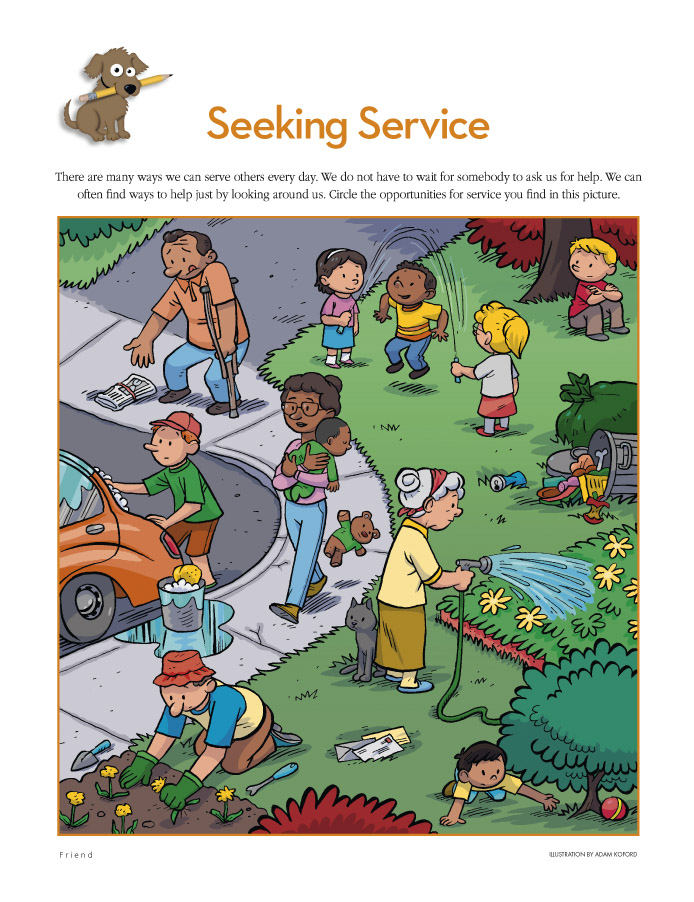
Service to others is an important characteristic of a disciple of Jesus Christ. Often Heavenly Father will meet the needs of others through you. There are many ways to serve others. Some of the most important service you can give will be within your own home. As you devote yourself to serving others, you will draw closer to Heavenly Father. Your heart will be filled with love. (For the Strength of Youth).

No comments:
Post a Comment